



Introduction
Read moreAs global risks – from technological disruption to geopolitical instability – become more interconnected, businesses are under growing pressure to understand and mitigate threats more effectively.
The objective of this study is to explore how business leaders perceive these risks and how such pressures influence their insurance purchasing decisions.
The objective of this study is to explore how business leaders perceive these risks and how such pressures influence their insurance purchasing decisions.
In this context, insurance is being reevaluated not merely as a compliance requirement, but as a strategic lever for organizational continuity, performance, and strength.
What has changed is not simply the risk environment, but the role insurance is expected to play in the enterprise.
Leading organizations increasingly see commercial insurance as part of their resilience toolkit, protecting earnings, preserving continuity, and supporting better risk decision-making at the leadership level.

Methodology
Read moreThe research was independently commissioned by WBN, in partnership with MarshBerry. The field research, conducted by Censuswide, surveyed 1,750 C-suite leaders (defined as Director+, all with some purchasing/renewing decision-making responsibility for business insurance within their organization) from mid-market and above companies (250+ employees) representing diverse industries across six major economies: the United States (US), Canada, the United Kingdom (UK), France, Germany, and Spain.
The study incorporated quantitative survey responses and supporting qualitative insights to build a multidimensional understanding of the following areas:
-
Organizational resilience strategies
-
Insurance perceptions and expectations
-
Business risk priorities
-
Broker relationship dynamics
This blended approach provides both statistical clarity and contextual understanding of the pressures facing modern enterprises.
Risk is increasingly global and interconnected, but execution still depends on local market knowledge, compliance discipline, and local claims and servicing capability.

Risk as a Resilience Lever
Read moreThe data shows that as pressures continue to intensify, organizational resilience has become a strategic imperative for global business leaders, with many viewing it as essential to navigating today's volatile operating environment.

When asked which were the most important factors for strengthening their ability to withstand disruption and recover while continuing to operate, nearly half of leaders cited a strong risk management strategy as the second most critical pillar of resilience.
This was a consistent ranking across all regions. Workforce and crisis preparedness was a close third, according to 37%.
Notably, this research was conducted prior to the onset of the current geopolitical conflict. As such, it is likely that the relative importance assigned to “crisis preparedness” would have been higher had the study taken place under present conditions.
The most important factors identified globally
| Innovation, R&D (Research and Development), and digital transformation | 53% |
| A comprehensive and proactive risk management strategy | 45% |
| Workforce adaptability and capability building | 37% |
| Effective crisis preparedness and response planning | 37% |
| Strong financial reserves | 34% |
| Clear governance and decision-making frameworks | 32% |
| Supply chain diversification | 27% |
| A culture of care and empowerment | 19% |

The data reveals a recognition across the board of risk management as a resilience strategy rather than a compliance cost.
-
When leaders were asked about their perception of commercial insurance within their organization, those in the US (49%) and Canada (48%) are more likely than the global average to view it as a strategic lever for resilience. The UK leads in this metric at 51%, while Germany trails at just 29%.
-
Only 3% globally perceive commercial insurance to be an "unavoidable expense", with France higher at 6%.
- A striking 87% expect insurance to become increasingly strategic over the next three years.
| A strategic investment that supports resilience and business performance | 43% |
| An important operational safeguard (risk protection and continuity) | 34% |
| A source of competitive advantage when managed well | 10% |
| A compliance requirement | 6% |
| A cost of doing business with limited perceived value | 3% |
| An unavoidable expense; insurance decisions are made mainly to minimize cost | 3% |
This shift underscores that resilience is no longer defined purely by operational robustness. Increasingly, it is about anticipating threats, innovating ahead of disruption and empowering people to adapt quickly. As insurance becomes more strategically integrated, organizations expect products and services that are tailored, data driven, and proactive, moving well beyond traditional coverage.
87%
A striking 87% expect insurance to become increasingly strategic over the next three years
What resonates most strongly from this research is just how rapidly insurance is evolving into a strategic tool for risk, capital, and workforce stability. It's becoming integral to business planning, not an afterthought. For organizations pursuing growth in a volatile world, insurance is now part of the value creation strategy."
Shane Carter
COO, WBN
Shifting Perceptions of Risk
Read moreThis study reveals a positive picture of risk management within organizations, with 93% of business leaders describing it as having a good reputation, and half of those going as far as calling it "very good". The UK leads globally, with 95% expressing positive perceptions, followed closely by the US at 94%.
This increased esteem reflects a broad recognition that risk teams are playing a growing role in guiding strategic decisions and enabling organizational resilience, but also the criticality of safeguarding an organization's assets and people in such uncertain times.
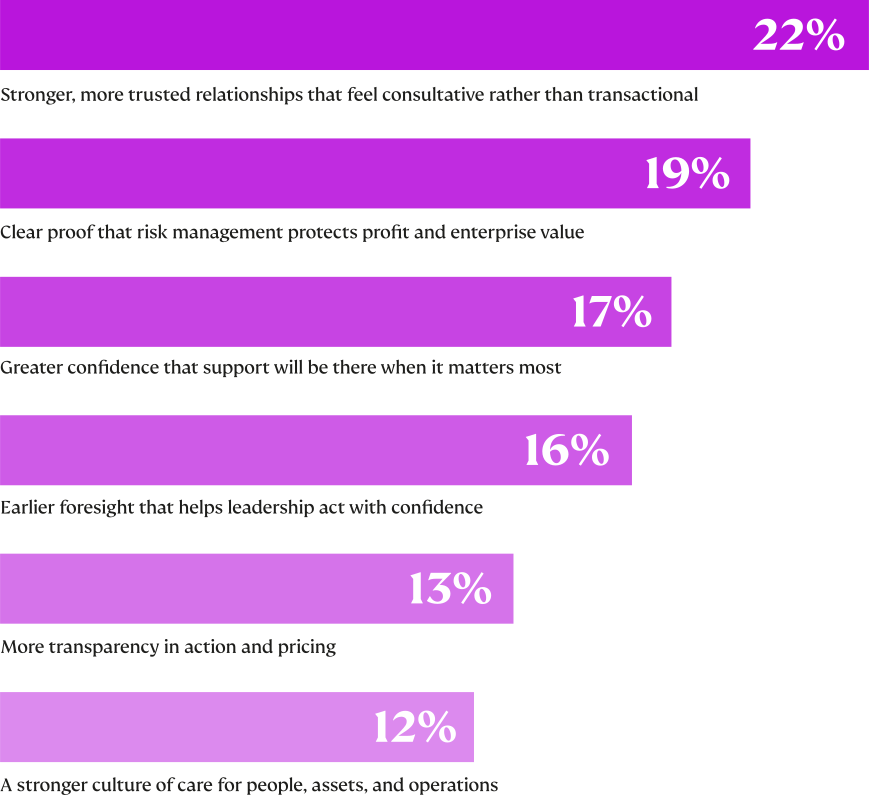
When asked what would most improve the perception of risk management within organizations, leaders highlighted their must-have factors, with the top three shown here.
| 1 | Stronger, more trusted relationships that feel consultative rather than transactional – 22% |
| 2 | Clear proof that risk management protects profit and enterprise value – 19% |
| 3 | Greater confidence that support will be there when it matters most – 17% |
Top factors for improving the perception of risk management within organizations
As risk managers collaborate more closely with executive leadership, the sector is steadily shifting from a compliance role to a central, respected business function with its contribution increasingly linked with
- Strengthening crisis readiness
- Supporting data-driven decision-making
- Enhancing cross-functional governance
- Building long-term organizational stability.

The favorable view of risk management is likely being earned through three things – more visible contribution to decision-making, closer alignment with leadership priorities, and better articulation of value.
We’re seeing risk management earn a seat at the strategic table, and this study confirms what we’re observing in the market every day. High-performing firms are empowering risk leaders to influence capital allocation, operational design, and long-term resilience planning, which is a transformational shift.”
Olga Collins
CEO, WBN
Top Business Risks and Concerns Relating to Insurance
Read moreLeaders today face an unprecedented breadth of business risks driven by geopolitical, economic, and workforce disruption. This study identifies the most pressing concerns keeping business leaders awake at night.
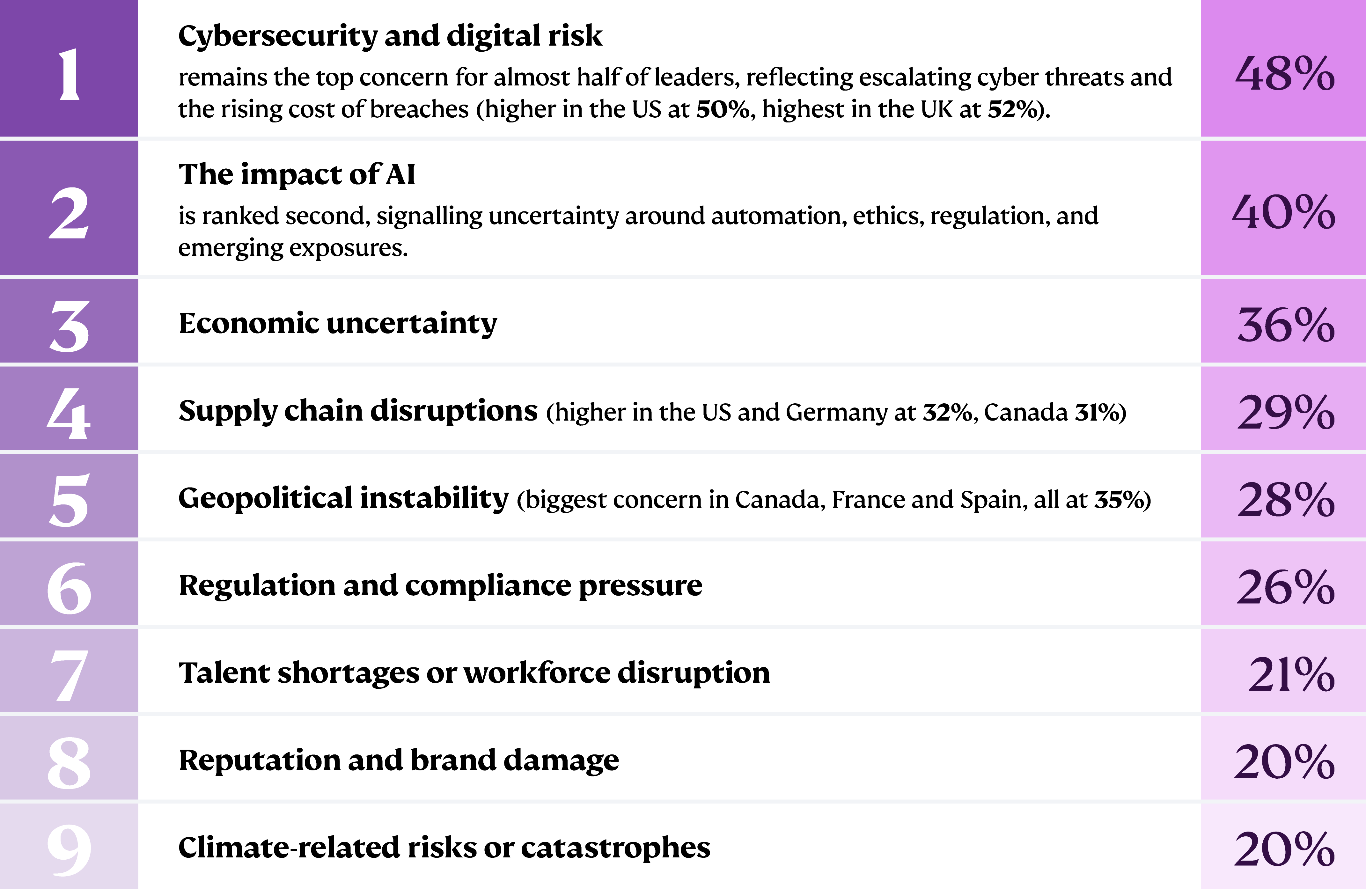
Together, these findings paint a picture of a risk environment shaped by rapid technological change, economic volatility, and ongoing workforce disruption. Critically, the risks leaders are most concerned about – cyber, AI, economic instability, and geopolitics – are deeply interconnected, compounding both exposure and complexity.

This is increasing demand for more sophisticated insurance solutions, clearer risk insight, and more proactive advisory support.
AI stands out as a defining example of this challenge. Ranked as the second‑highest concern overall, leaders recognize its potential to transform business performance, yet remain uncertain about the risks it introduces. For commercial buyers, AI exposes organizations to a broad set of emerging issues, including liability, data privacy and security, intellectual property, and evolving regulatory obligations. At the same time, AI remains a nascent area for the insurance industry, with underwriting approaches still developing and exclusions increasingly appearing within traditional policies – creating the risk of hidden or unintended coverage gaps.
This combination of rising exposure and limited clarity presents a meaningful opportunity for the insurance distribution sector. Brokers and insurers have a pivotal role to play in helping organizations interpret evolving coverage, identifying where risk and protection are misaligned, and designing programs that properly reflect today’s risk realities. In this context, the excess and surplus (E&S) and wholesale markets are likely to become increasingly important, providing flexibility and innovation as the industry adapts to emerging and non‑traditional risks.
When asked how confident leaders were that their organization has adequate insurance cover/capacity, there were some worrying responses:
- A quarter globally are not confident they have adequate cover for geopolitical risks
- 22% are not confident on economic uncertainty
- 17% are not confident about climate-related risks.
89%
confident about having cover for regulation and compliance pressure
Other Insurance-Related Concerns
Despite recognizing the strategic importance of insurance, leaders remain concerned about several persistent challenges when it comes to selecting and renewing insurance.
| Rising premiums and affordability are the most pressing insurance-related worries (highest in the US and Canada, lowest in Spain) | 47% |
| Gaps in cyber insurance pose major issues, particularly given the centrality of cyber threats (higher in the US, highest in the UK). | 43% |
| Natural catastrophe damages outpacing insurance cover/capacity was a consistent worry across regions | 40% |
| Insurance partners not being consultative/proactive enough ranked highest in the US | 39% |
| Claims volatility | 30% |
| Not being adequately covered for risks | 27% |

These findings suggest that while demand for coverage is increasing, confidence in available products – particularly around cyber – lags behind.
Affordability as a leading concern reflects years of sustained rate pressure, including double-digit increases in some markets. While conditions are improving, particularly in property, buyers remain highly valu- focused. At the same time,
40%
do not see their partners as sufficiently consultative or proactive
– indicating that dissatisfaction extends beyond products to service models. This presents an opportunity for brokers to strengthen relationships through client education, exposure alignment, and more tailored, proactive guidance.”
Jen Blair
Global Director of P&C and Product Development, WBN
Purchasing Priorities
Read moreThe study explores what is most important to leaders when selecting or renewing an insurance partner. What stands out is the pressure involved in making global risk management decisions in an increasingly complex world. The speed of change in emerging risks, such as cyber and geopolitical, emerges as the top pressure.
This is followed by “the ability to analyze and quantify corporate risk appetite and tolerance”, which almost 20% ranked as their second biggest worry, just ahead of “gaps in global coverage across international operations” – both presenting definite opportunities for brokers as consultants in these spaces.
The takeaway here is that leaders face a series of varying and competing pressures when making risk management decisions, so approach and guidance must be bespoke to each specific client and industry. There is no one-size-fits-all.
| The speed of change in emerging risks (e.g., cyber, geopolitical, ESG) | 26% |
| Ability to analyze and quantify corporate risk appetite and tolerance | 17% |
| Gaps in global coverage across international operations | 15% |
| Making a decision that negatively impacts profitability | 12% |
| Inability to demonstrate ROI or business value | 10% |
| Failure to meet regulatory or compliance obligations | 9% |
| Insufficient local market knowledge | 5% |
Quality, cost, and the need to demonstrate ROI emerge as the main drivers for purchasing decisions, coupled with having strong personal relationships with broker teams, which almost a third of all respondents cite as essential.
When selecting or renewing an insurance partner, almost half of business leaders ranked quality of service delivery as the most influential factor. Price and total cost of risk was ranked second, while innovation, digital tools, and data capabilities were a close third. Being able to quantify and demonstrate ROI and having expertise in international and cross-border programs was also one of the top five most important factors.
| Quality of service delivery | 46% |
| Price and total cost of risk | 40% |
| Innovation, digital tools, and data capabilities | 39% |
| Ability to quantify and demonstrate ROI | 35% |
| Expertise in international and cross-border programs | 30% |
| Strength of personal relationships with broker teams | 29% |
| Specialization in my industry | 28% |
| Breadth of network and global reach | 27% |

The ranking is telling. Buyers are still anchored in service and economics, but innovation, digital tools, and ROI are nearly as important. This suggests that a modern broker value proposition needs to combine reliable execution, commercial value, and evidence of impact.
When assessing which elements/criteria of a global risk management program are most important to their organization, respondents provided the following insights:
-
A quarter globally – and 30% in the US – say that consistent, continuous broker relationships are the most important, alongside having broad market access (local insurers, wholesale, London market, etc.)
- 96% stress the importance of having strong local broker relationships in each country where they operate. Why is this so important?
- Almost half of business leaders globally say that faster response times is the most important benefit to having local broker presence
- 42% cite on-the-ground understanding of local regulations as the second most important driver
- 37% say that an important part of having a local broker presence is handling claims in the local language and their understanding of cultural and business norms
- 94% say it is important that their broker is part of (or has access to) a strong international network (highest in the US and Canada at 96%)
- 74% say the account is at risk if the international relationship is not succeeding:
- 20% say the account is in high risk
- Over half say it is in some risk.
In commercial insurance, relationship strength still matters because complex placements, claims, and local execution all rely on trust, responsiveness, and knowledge.
Technology can improve visibility, speed, and lend credibility, but it does not remove the need for expert human advice. If anything, over time, the growth of technology, AI adoption, and data availability is likely to place an even greater premium on expert human advice."
Olga Collins
CEO, WBN
96%
stress the importance of having strong local broker relationships in each country
47%
faster response times is the most important reason for local broker presence

What, if any, elements /criteria of a global risk management program are most important to your organization?
| Access to collaborative technology and reporting tools | 29% |
| Total cost of risk assessments | 29% |
| Enterprise risk management services | 29% |
| Consistency and continuity of broker team relationships | 25% |
| Compliance reviews and monitoring | 25% |
| Claims advocacy and management | 24% |
| Market access (local insurers, wholesale, London market, etc.) | 24% |
| Benchmarking and market trends insights |
19% |
| Broker cost transparency | 19% |
| Local broker strength and expertise | 18% |
| Loss control services | 16% |
| Pre-underwriting capabilities | 13% |
The results highlight just how complex and demanding global risk management expectations have become. Three priorities – technology and reporting capabilities, total cost of risk assessment, and enterprise risk management services – emerge as the most important, reflecting the need for integrated, insight‑driven programs rather than single‑issue solutions.
Even beyond this leading tier, continuity of broker relationships and robust compliance oversight follow closely behind, reinforcing that clients expect breadth, depth, and consistency from their risk partners, not trade‑offs.
Why, if for any reason in particular, is/could a local broker presence be important to you for your global operations?
| Faster response times | 47% |
| Support during crises and incidents | 45% |
| Local market expertise and insurer relationships | 44% |
| On-the-ground understanding of local regulations | 42% |
| Local compliance monitoring | 37% |
| Claims handling in local language | 37% |
| Cultural and business norms understanding | 37% |
Challenges in Implementation
Read more
Leaders surveyed in our study were very vocal and honest about the challenges they experience most often in a typical year when managing their organization's global insurance program.
| Challenges aligning insurance/employee benefits across markets | 31% |
| Slow turnaround or confusion when changes need to be made globally (35% in France) | 29% |
| Lack of visibility or control from HQ over local placements (32% in the US) | 28% |
| Difficulty ensuring local teams follow the global strategy | 27% |
| Local brokers not fully understanding the global program or objectives | 27% |
| Inconsistent advice or approaches across countries | 26% |
| Duplication of effort, data, or reporting across territories | 25% |
| Difficulty holding local brokers accountable for delivery | 23% |
These are exactly the kind of pain points sophisticated brokers should be solving through technology, standardized workflows, central stewardship, and clearer local market accountability.
This section also complements the earlier finding that buyers want local presence and strong networks. They do not want local autonomy without central control; they want the two to work together.
The emphasis executives place on strong local broker relationships is a clear signal. Businesses don't just need insurance – they need solutions that are global, but that can also align locally.
Partners who can interpret market nuances, regulatory detail, and emerging threats in real time. That combination of local acuity and global insight is now a competitive differentiator.”
Liz Yovich Pan
Director of Global Engagement and Employee Benefits, WBN
United States
Read more
We are experiencing clients becoming far more deliberate about resilience — they still watch costs closely, but the real differentiator now is how they invest in innovation and strengthen their risk management foundations.
Cyber threats and AI disruption are accelerating faster than ever, and we as brokers need to match that pace with genuine global coordination and strong local execution."
Scott Davis
EPIC
Perceptions
Most important factors for organizational resilience
- Innovation, R&D, and technology investment 55%)
- Proactive risk management strategy (45%)
- Workforce adaptability and capability building (42%).
Half (49%) view commercial insurance primarily as a strategic investment that supports resilience and business performance, a third view it as an important operational safeguard (33%).
Main reputational improvement drivers within organizations
- Stronger, more trusted relationships that feel consultative rather than transactional (24%)
- Clear proof that risk management protects profit and enterprise value (21%)
- Greater confidence that support will be there when it matters most (16%).
Pressures
Business risks of most concern over next 12–24 months
- Cybersecurity and digital risk (50%)
- Impact of AI (44%)
- Economic uncertainty (37%).
Top insurance-related concerns
- Rising premiums/affordability issues (51%)
- Cyber insurance gaps (49%)
- Insurance partners not being consultative/proactive enough (45%)
- Natural catastrophe damages outpacing insurance cover/capacity (40%)
- Claims volatility (33%).
Top challenges in managing risk
- Challenges aligning insurance/employee benefits across markets (34%)
- Lack of visibility or control over local placements (31%)
- Slow turnaround or confusion with global changes (31%).
Priorities
Most influential factors when selecting a broker
- Quality of service delivery (50%)
- Innovation, digital tools, and data capabilities (43%)
- Ability to quantify and demonstrate ROI (39%).
Most important criteria for global risk programs
- Enterprise Risk Management services (33%)
- Access to collaborative technology and reporting tools (31%)
- Consistency and continuity of broker team relationships (30%).
Why local presence matters
- Faster response times (51%)
- Support during crises and incidents (50%)
- Local market expertise and insurer relationships (46%).
96% say it is important that their broker is part of (or has access to) a strong international network.
Canada
Read more
Canadian businesses are navigating the same global risks as everyone else — cyber, AI, economic uncertainty — but their biggest challenge is ensuring local teams stay aligned to global strategy.
Our clients are looking for partners who bring clarity, consistency, and cost discipline without losing sight of innovation.”
Meghan Callaghan
Hub International Limited
Perceptions
Most important factors for organizational resilience
-
Innovation, R&D, and technology investment (53%)
-
Proactive risk management strategy (49%)
-
Workforce adaptability and capability building (37%).
Almost half (48%) view commercial insurance primarily as a strategic investment that supports resilience and business performance, a third view it as an important operational safeguard (31%).
Main reputational improvement drivers within organizations
-
Stronger, more trusted relationships that feel consultative rather than transactional (21%)
-
Greater confidence that support will be there when it matters most (20%)
-
Earlier foresight that helps leadership act with confidence (18%).
Pressures
Business risks of most concern over next 12–24 months
-
Cybersecurity and digital risk (44%)
-
Impact of AI (43%)
-
Economic uncertainty (37%).
Top insurance-related concerns
-
Rising premiums/affordability issues (51%)
-
Cyber insurance gaps (40%)
-
Natural catastrophe damages outpacing insurance coverage/capacity (36%)
-
Insurance partners not being consultative/proactive enough (34%)
-
Claims volatility (33%).
Top challenges in managing risk
-
Difficulty ensuring local teams follow global strategy (34%)
-
Challenges aligning insurance/employee benefits across markets (31%)
-
Local brokers not fully understanding the global program or objectives (28%).
Priorities
Most influential factors when selecting a broker
-
Price and total cost of risk (48%)
-
Quality of service delivery (46%)
-
Ability to quantify and demonstrate ROI (41%).
Most important criteria for global risk programs
-
Total cost of risk assessments (35%)
-
Enterprise Risk Management services (34%)
-
Consistency and continuity of broker team relationships (28%).
Why local presence matters
-
Faster response times (54%)
-
Local market expertise and insurer relationships (49%)
-
On-the-ground understanding of local regulations (45%)
96% say it is important that their broker is part of (or has access to) a strong international network.
France
Read more
For French organizations, resilience is built on proactive risk management and crisis preparedness.
Their concerns around digital transformation and global program complexity are real, and we as brokers are expected to provide earlier foresight and faster global responsiveness.”
Benjamin Verlingue
Verlingue
Perceptions
Most important factors for organizational resilience
-
Innovation, R&D, and technology investment (46%)
-
Proactive risk management strategy (46%)
-
Effective crisis preparedness and response planning (39%).
Over a third (35%) view commercial insurance primarily as a strategic investment that supports resilience and business performance, followed closely by an important operational safeguard (30%).
Main reputational improvement drivers within organizations
-
Earlier foresight that helps leadership act with confidence (23%)
-
Clear proof that risk management protects profit and enterprise value (20%)
-
Stronger, more trusted relationships that feel consultative rather than transactional (20%).
Pressures
Business risks of most concern over next 12–24 months
-
Cybersecurity and digital risk (45%)
-
Impact of AI (43%)
-
Geopolitical instability (35%).
Top insurance-related concerns
-
Rising premiums/affordability issues (48%)
-
Natural catastrophe damages outpacing insurance coverage/capacity (41%)
-
Insurance partners not being consultative/proactive enough (35%)
-
Cyber insurance gaps (35%)
-
Not being adequately covered for risks (25%).
Top challenges in managing risk
-
Slow turnaround or confusion when changes need to be made globally (35%)
-
Difficulty ensuring local teams follow global strategy (29%)
-
Challenges aligning insurance/employee benefits across markets (29%).
Priorities
Most influential factors when selecting a broker
Most influential factors when selecting a broker
-
Price and total cost of risk (45%)
-
Quality of service delivery (44%)
-
Innovation, digital tools, and data capabilities (36%).
Most important criteria for global risk programs
-
Claims advocacy and management (27%)
-
Total cost of risk assessments (25%)
-
Access to collaborative technology and reporting tools (25%).
Why local presence matters
-
Support during crises and incidents (42%)
-
Faster response times (39%)
-
Local market expertise and insurer relationships (38%).
92% say it is important that their broker is part of (or has access to) a strong international network.
Germany
Read more
German companies remain operationally disciplined, but the volatility of cyber and geopolitical risks is reshaping their priorities.
Clients need industry‑specific expertise and brokers who can help them navigate regulatory nuance while improving consistency across markets.”
Ralf Bender
SÜDVERS
Perceptions
Most important factors for organizational resilience
-
A comprehensive and proactive risk management strategy (48%)
-
Clear governance and decision-making
frameworks (48%)
-
Effective crisis preparedness and response planning (42%).
45% view commercial insurance primarily as an important operational safeguard, followed by a strategic investment that supports resilience and business performance (29%).
Main reputational improvement drivers within organizations
-
Earlier foresight that helps leadership act with confidence (23%)
-
Stronger, more trusted relationships that feel consultative rather than transactional (23%)
-
Clear proof that risk management protects profit and enterprise value (18%).
Pressures
Business risks of most concern over next 12–24 months
-
Cybersecurity and digital risk (44%)
-
Economic uncertainty (41%)
-
Geopolitical instability (35%).
Top insurance-related concerns
-
Rising premiums/affordability issues (43%)
-
Natural catastrophe damages outpacing insurance coverage/capacity (43%)
-
Cyber insurance gaps (43%)
-
Not being adequately covered for risks (33%)
-
Insurance partners not being consultative/proactive enough (30%).
Top challenges in managing risk
-
Duplication of effort, data, or reporting across territories (30%)
-
Difficulty ensuring local teams follow the global strategy (29%)
-
Lack of visibility or control from HQ over local placements (28%).
Priorities
Most influential factors when selecting a broker
-
Quality of service delivery (44%)
-
Price and total cost of risk (38%)
-
Ability to quantify and demonstrate ROI (36%).
Most important criteria for global risk programs
-
Total cost of risk assessments (29%)
-
Access to collaborative technology and reporting tools (29%)
-
Compliance reviews and monitoring (28%).
Why local presence matters
-
Faster response times (43%)
-
Cultural and business norms understanding (41%)
-
Local market expertise and insurer relationships (40%).
92% say it is important that their broker is part of (or has access to) a strong international network.
Spain
Read more
Spanish businesses are feeling the pressure of economic uncertainty and geopolitical instability, and they rely heavily on local regulatory understanding to stay compliant and agile.
Rising premiums and catastrophe exposure are front of mind, so they expect brokers to demonstrate real value and tighter global alignment.”
João Almeida-Santos
Grupo Concentra
Perceptions
Most important factors for organizational resilience
-
Innovation, R&D, and technology investment (64%)
-
Effective crisis preparedness and response planning (43%)
-
Proactive risk management strategy (42%).
Over a third (35%) view commercial insurance primarily as a strategic investment that supports resilience and business performance, followed closely by an important operational safeguard (32%).
Main reputational improvement drivers within organizations
-
Clear proof that risk management protects profit and enterprise value (20%)
-
Greater confidence that support will be there when it matters most (19%)
-
Stronger, more trusted relationships that feel consultative rather than transactional (19%).
Pressures
Business risks of most concern over next 12–24 months
Business risks of most concern over next 12–24 months
-
Cybersecurity and digital risk (46%)
-
Geopolitical instability (36%)
-
Economic uncertainty (34%).
Top insurance-related concerns
-
Natural catastrophe damages outpacing insurance coverage/capacity (40%)
-
Rising premiums/ affordability issues (37%)
-
Not being adequately covered for risks (36%)
-
Insurance partners not being consultative/proactive enough (36%)
-
Claims volatility (30%).
Top challenges in managing risk
-
Challenges aligning insurance/employee benefits across markets (31%)
-
Slow turnaround or confusion when changes need to be made globally (31%)
-
Difficulty holding local brokers accountable for delivery (27%).
Priorities
Most influential factors when selecting a broker
-
Price and total cost of risk (39%)
-
Specialization in my industry (38%)
-
Breadth of network and global reach (35%).
Most important criteria for global risk programs
-
Access to collaborative technology and reporting tools (28%)
-
Total cost of risk assessments (26%)
-
Benchmarking and market trends insights (26%).
Why local presence matters
-
Faster response times (47%)
-
On-the-ground understanding of local regulations (43%)
-
Support during crises and incidents (39%).
90% say it is important that their broker is part of (or has access to) a strong international network.
United Kingdom
Read more
As traditional risk boundaries blur and new challenges like AI and cyber risk emerge, clients are increasingly looking for more than just capacity. They require brokers who can provide laser-focused risk transfer solutions for their most complex placements. The future of our industry lies in combining deep specialist knowledge with a truly global reach to create clarity and confidence in an uncertain world.”
Charles Bromfield
McGill and Partners
Perceptions
Most important factors for organizational resilience
-
Innovation, R&D, and technology investment (57%)
-
Proactive risk management strategy (45%)
-
Workforce adaptability and capability building (44%).
Over half (51%) view commercial insurance primarily as a strategic investment that supports resilience and business performance, followed by an important operational safeguard (36%).
Main reputational improvement drivers within organizations
-
Stronger, more trusted relationships that feel consultative rather than transactional (21%)
-
Clear proof that risk management protects profit and enterprise value (20%)
-
Greater confidence that support will be there when it matters most (20%).
Pressures
Business risks of most concern over next 12–24 months
Business risks of most concern over next 12–24 months
-
Cybersecurity and digital risk (52%)
-
Impact of AI (38%)
-
Economic uncertainty (36%).
Top insurance-related concerns
-
Cyber insurance gaps (52%)
-
Insurance partners not being consultative/proactive enough (42%)
-
Rising premiums/affordability issues (41%)
-
Natural catastrophe damages outpacing insurance coverage/capacity (40%)
-
Claims volatility (29%).
Top challenges in managing risk
-
Challenges aligning insurance/employee benefits across markets (33%)
-
Inconsistent advice or approaches across countries (29%)
-
Local brokers not fully understanding the global program or objectives (29%).
Priorities
Most influential factors when selecting a broker
-
Quality of service delivery (55%)
-
Innovation, digital tools, and data capabilities (45%)
-
Price and total cost of risk (35%).
Most important criteria for global risk programs
-
Access to collaborative technology and reporting tools (33%)
-
Total cost of risk assessments (33%)
-
Enterprise Risk Management services (33%).
Why local presence matters
-
Local market expertise and insurer relationships (52%)
-
Support during crises and incidents (48%)
-
Local compliance monitoring (43%).
95% say it is important that their broker is part of (or has access to) a strong international network.


WBN is the world’s largest network of leading independent insurance broking and employee benefits firms.

A global leader in investment banking
and consulting.